

-6.avif)
Last week at a business networking event, I went a bit off the rails.
I described selling townhouses in 2021 as flying like hot sh*t off a shovel.
Then I described selling the exact same product in 2024 and 2025 as flying like baked on sh*t off a shovel. One is airborne. The other needs a sandblaster. I'm a dog owner, I know these scenarios well. I'm also a property developer, so the analogy relates.
Crass. Yes.
Accurate. Unfortunately, also yes.
And judging by the room’s reaction, the analogy landed!
Here's why; in a cyclical market like property, relying on product:market fit is Russian roulette. Will the market be hot when you need to sell. Or will it be frozen solid. And the harder question: how many developers exactly like you are dumping the same product into the same areas at the same time. If you don't know the data, good luck to you.
We spoke to a townhouse developer last week who joked:
“I will be the first to drop my pants to get a sale.”
This is exactly what happens.
Pants get dropped.
Margins get squeezed.
Your product becomes a commodity.
The only tool left is a price drop and your neighbour is dropping theirs faster than you are.
We have lived through this. We fell victim to it years ago. It is not fun.
It's said that the market 'goes up the escalator and down through the window'.
Confidence rises slowly. Projects get bigger. Risk increases. Then the cycle turns. If you are holding a large development of unsold homes when it turns, you can be royally stuffed.
This is apparently the case in Auckland right now. People got greedy, went for more and more density (which looks great on the initial spreadsheet btw).
Rows of plaster boxes, squeezed together, no differentiation. Reports of open homes with three buyers wandering around while the agent is trying to shift forty two units. That is brutal.
But that is the cost of chasing product-market-fit. You are hoping the middle part of the equation, the market, is hot at the exact moment you release your stock.
We decided to stop playing that game.
We replaced market with customer.
Instead of designing mid level tripe and hoping the masses will lap it up, we narrowed our Total Addressable Market from “anyone with a pulse and a mortgage approval” to a tiny, specific demographic.
Our customer is now:
Active, healthy, wealthy Kiwis over 60 who want to downsize within five kilometres of their current neighbourhood.
They want familiarity. Stability. Community. Connection. They want to stay close to the GP they trust, the supermarket they know, the cafes they enjoy and the people they love.
Our job is simple:
Develop infill homes in established areas so they never have to leave the life they know.
This shrinks our TAM massively. But the clarity it provides is worth its weight in gold.
Christchurch has roughly 74,000 people aged 60 and over. Half are considering downsizing. Half again fit our avatar of healthy, wealthy and active. That leaves about 17,000 people who could be Rosefern customers.
Not millions.
Seventeen thousand.
And suddenly our design decisions make sense.
When you build for the masses, you never think about the small things that matter.
• Raising the washing machine so you do not injure your back.
• Choosing handles instead of knobs because grip strength reduces as we age.
• Avoiding cedar on the second storey because no one wants their grandad up a ladder staining cladding every 3 years.
• Designing downstairs masters so people can age in place.
• Including solar as standard to keep outgoings down in later life.
These details matter. You only discover them when you build for a specific human being, not a vague market.
The biggest driver for us is health. An 85 year Harvard study on happiness showed loneliness in older age is comparable to smoking a pack of twenty a day. That is frightening. But it explains everything.
Moving people away from their familiar supermarkets, local GPs, walking routes, baristas who know their name and order and social circles can be devastating. It impacts physical wellbeing too.
Yet many single storey options for downsizers are being built on the outskirts, where land is cheap and density is not required. Convenience is replaced with isolation.
So we design for single level living. Downstairs master bedrooms. Downstairs ensuites. Simple, comfortable, future proof homes.
We had an Ironman competitor in his 60s buy one of our homes with a 20 year view. That told us how strong the demand really is. He's fit as a butchers dog right now, but he's smart, looking ahead 20 years and future proofing, getting a foot on a property today, that he will be happy to live in in his 80s+
And unlike the typical townhouse buyer, most downsizers are cash buyers. No finance clauses. No waiting for the bank to decide your future. They sell a larger home, buy ours, and often walk away with cash left over.
Our Home Exchange program strengthens the fit even more. We can be the buyer of their old home. Their land. Their portfolio. One move. One decision. Simplicity.
Most developers ask:
“What can I build on this land.”
We ask:
“Who will live here. How old are they. What matters to them. What do their weekends look like.”
Then we design for that person.
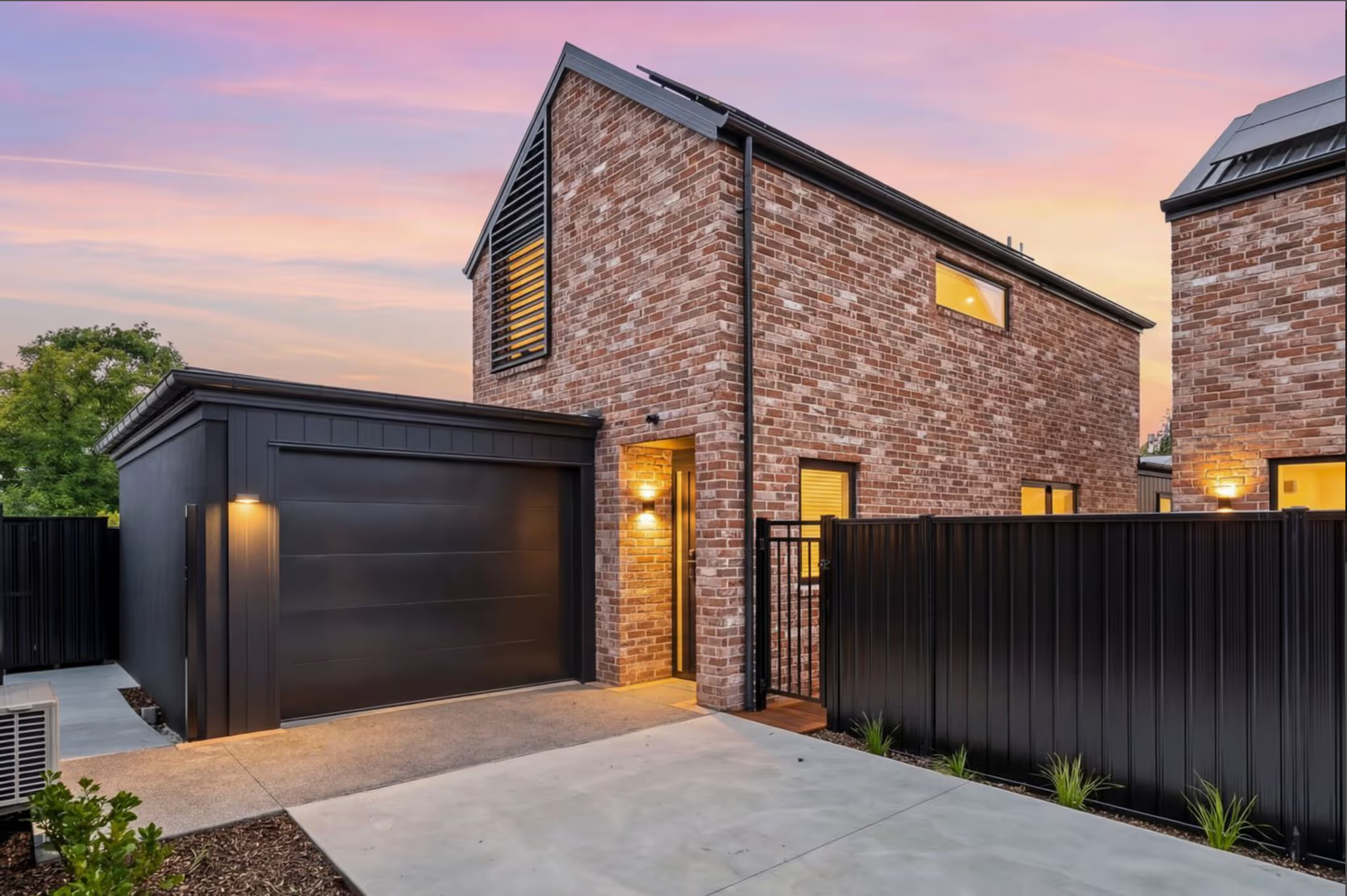
Take 92 Tennyson Street. We could have squeezed nine or ten units on that site. But we did not. Because squeezing units might maximise gross yield, but it destroys brand integrity. And the customer we serve would never buy it anyway.
We created downsizer specific homes instead. The development is almost sold out. We have held one back for auction to set a high comparable sale and reward early buyers. Intentional.
92 Tennyson Street will be our showcase.
Videos. Walkthroughs. Photography. A podcast filmed on site.
It is the first of many.
Six in total. Three bed standalones with garages and downstairs masters.
Homes designed for lifestyle, not the zoning rules.
Five years ago we did not have this clarity. If you are a new developer reading this, take note. Learn this early. It will save you millions and years of frustration.
Competition forced us to think differently. And now our tagline, Built Different, is finally true.
When you stop building for a vague market and start building for a specific customer:
• You attract the people who want to work with you
• Competitors become irrelevant.
• Supply and demand tilt in your favour.
• Margins improve.
• Word of mouth compounds.
• Your homes stop being commodities and start becoming a brand.
Daniel Priestley nails it in Oversubscribed.
If demand exceeds supply, you have a real business.
Product-customer-fit puts you in that position.
You stop hoping the market is hot.
You create something customers want no matter what the market is doing.
Thanks for reading my rants this week, I hope there has been some insight into how we operate here at Rosefern.
P.S. If you follow us on socials, you would have seen a very exciting announcement. We are undertaking our first development in the beautiful Queenstown!
Stay tuned for more information on the release. There will only be a select number of homes available and it will be on a first come, first served basis. We'll have a page up soon for you to register your interest!
Ant
-5.avif)